
Welcome to the Town of Gilbert’s Performance Management Portal
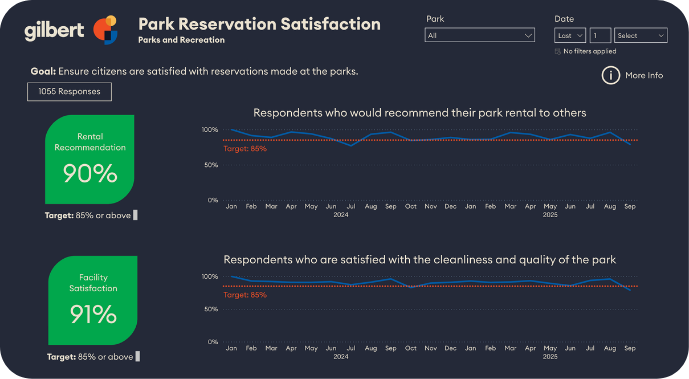
Your central hub for real-time insights, progress tracking, and key performance metrics. Explore our website to learn more about the program, history, and current progress, and see how our departments have developed powerful dashboards to support data-informed decision-making and help us continue to serve the Gilbert community effectively.
Select a Tab to get started!
Department Performance
Transparency and accountability are at the core of our operations. Our Department’s Data section comprehensively examines key performance metrics, operational trends, and program outcomes. From budget allocations to service delivery insights, this hub provides accessible, up-to-date information to keep residents, stakeholders, and decision-makers informed. By sharing data openly, we aim to foster trust, drive innovation, and support evidence-based policy decisions that enhance our community’s quality of life.
Mission
The Town of Gilbert’s Performance Management Program is a forward-thinking initiative aligned with its vision of becoming the City of the Future by focusing on:
Real-time dashboards and advanced analytics inform policy and operational decisions.
Metrics align with long-term goals to ensure consistent progress and measurable results.
Regular review and adaptation drive innovation and efficiency across departments.
Open access to performance data builds trust and promotes responsible governance.
We incorporate public input and emerging trends to meet the Town of Gilbert’s evolving needs.
Together, these efforts support sustainable growth and maintain a high quality of life in Gilbert.
Core Performance Team
The Core Performance Team is a cross-departmental group composed of representatives from various roles throughout Gilbert. This diverse team has united to oversee the onboarding and ongoing management of the Performance Management Program, bringing together a wide range of expertise and skill sets.
Core Performance Team
Town of Gilbert · Organizational Structure
If you would like to know more about our program, please reach out to coreperformance@gilbertaz.gov
Our Journey
2018
Executive Team “Moonshot” Retreat
On-going and growing participation in regional benchmarking efforts and incorporation of data into annual budget process. City of the Future mission is conceptualized
Development of the City of the Future Strategic Initiative
2019
City of the Future Concept Development
Fast tracking org-wide metrics deemed important to ensure continued high quality of life
2020
Partnerships & Pilot
Gartner Data Governance Maturity Assessment
Pilot Program with Public Works, WWC & GovEx
Development of Implementation Strategies for performance management and data governance
2021
Laying the foundation for the Program
Executive Leadership role created to guide the Performance Management Strategy
Inspired by other government organizations and adapting to the culture of Town of Gilbert
Refined Phase II Pilot with Police Department
2022
Building the Team
Core Performance Team organized cross-functionally, creating a unique implementation strategy
Hosted Core Team Retreats and Debriefs to gather lessons learned and develop new action items
2023
Streamlining Engagements
Expansion and Formalization of Core Team Roles
Leveraging existing technologies and tools to streamline engagements with new departments
Development of business process and automation for efficiency and consistency across the Town
Initial Release of Public Dashboard for Public Works, Police
2025
Advancing Performance Management and AI Integration
Team re-alignment with the AI Strategy and Transformation Office to support emerging trends and technologies
Continued Onboarding of Departments into the Performance Management Program and release of Public Dashboards as approved
2026 and Beyond
Over the Horizon
Town-wide engagement in TownStat Meetings to discuss progress, challenges, and strategic alignment
Redesign and relaunch of Performance Management Websites
Continuous Improvement reviews of the program, training materials, and associated processes. Shifting team focus from Onboarding to Strategic activities
Program Status
Departments undergo an extensive onboarding process into the Performance Management Program, which consists of multiple sprints to gather data, develop goals and targets, and define appropriate metrics aligned with the Council’s and the Town Manager’s Office’s strategic initiatives. Below is our current progress.
Performance Management Program
Department Onboarding Schedule · Town of Gilbert, Arizona
Program Performance Summary
Public Works (Phase 1) – Jan 2021
Police (Phase 2) – Aug 2023
Management & Budget (Phase 3) – Nov 2024
Phase 3 (Late): Development Services, Economic Development
Phase 4 (Mid–Late): Finance & Mgmt Services, Parks & Rec, Engineering Services
Phase 5 (Mid–Late): People Team, IT
Average time in active status: 20+ months
Court, Fire, Prosecutor, Town Clerk
Strategic pause for capacity management
Phase 7: Communications & Engagement, General Counsel, Town Manager
Phase 8: Intergovernmental Affairs, Mayor & Council, AI Strategy & Transformation
Key Program Metrics
Strategic Alignment
Detailed Progress
This Dashboard is updated daily to show the overall progress of tasks related to onboarding with the Performance Management Onboarding process.
Contact Us
Can’t find what you’re looking for? We’re here to help. Fill out the form below, and a member of our team will follow up with you shortly.
What to Expect: Our team reviews submissions regularly and will respond within 3–5 business days. Complex requests, such as adding new datasets, may take additional time. We appreciate your patience as we work to make Gilbert’s data accessible to everyone.
Community Characteristics
Vital Statistics
MAG Population & ESRI Statistics Dashboard
Community Demographic Data
Gilbert has identified the most recent MAG population estimate as the preferred population figure for presentations, combined with ESRI current-year estimates as the preferred source for accompanying demographic data (e.g., Educational Attainment, Population by Age).
Using MAG and ESRI as standard data sources ensures consistency across departments, reduces discrepancies in public-facing materials, and aligns with the expectations of businesses, developers, and site selectors who rely on current-year data for investment decisions.
Certain use cases — including budget and finance reporting, grant compliance, regional coordination, or federal reporting — may require U.S. Census Bureau (ACS) data. In such cases, departments should clearly document the rationale for using alternative sources to maintain transparency and data integrity.
Data Source Reference
| Source | Area Used | Best For | Notes |
|---|---|---|---|
| MAG — Maricopa Association of Governments | MPA (72.6 sq mi) | Population estimates for presentations | Preferred population figure for most Town materials |
| ESRI — Business Analyst / ArcGIS | Incorporated Area (68.9 sq mi) | Demographic data (age, income, education, race) | Current-year estimates; updated annually; preferred for accompanying demographic data |
| U.S. Census / ACS — American Community Survey | Incorporated Area (68.9 sq mi) | Federal reporting, grants, budget/finance | Required in certain compliance contexts; document rationale when used |
Standard Footnote Format
When presenting MAG population with other demographic data, include the following footnote:
*Maricopa Association of Governments 20XX Population Estimate, **ESRI Business Analyst, ESRI, Inc. XXXX.
Replace 20XX with the applicable MAG estimate year and XXXX with the ESRI data year.
About ESRI Demographics
ESRI Demographics is a comprehensive collection of authoritative demographic data available across ArcGIS, covering over 170 countries and regions. Data includes population, age, race, income, households, and more, with consistent methodology enabling effective comparison across communities and markets.
U.S. Census Bureau ACS data is integrated within ESRI’s GIS software and updated annually. ESRI’s methodology is transparent, nationally recognized, and built on foundational Census data enhanced with additional sources and modeling techniques to reflect near real-time conditions.
ESRI’s data also supports public safety operations, offering granular neighborhood-level population and housing estimates that can inform resource deployment, emergency preparedness, and risk analysis.
Additional Data Resources
The Town of Gilbert subscribes to third-party data vendors that provide valuable data across a range of departments. For access to vendor data related to economic development, site selection, business intelligence, or market analysis, please contact the Office of Economic Development directly.
Questions about this data?
Contact the Office of Economic Development for third-party data resources, or the Core Performance Team for guidance on data source selection and Town reporting standards.
Data Service Standard
Gilbert’s Data Service Standard defines how we design, build, and maintain data and analytics services, ensuring every service we publish is purposeful, accessible, and trustworthy. These 17 standards guide our work from the first sprint to ongoing operations, grounded in our commitment to transparency, resident outcomes, and evidence-based decision-making.